
landmark
Plaza Uta el-Hammam
The main social square where mountain air meets cafe terraces. Sit at peripheral cafes to avoid inflated center-table tabs.
Morocco
Riffian mountain town defined by steep steps and blue wash.
Chefchaouene clings to the slopes of the Rif Mountains below two horn-shaped peaks. You navigate its blue-painted medina entirely on foot, ascending steep cobblestone stairways. The town sits far from Morocco's main rail network, so arrival requires a winding mountain drive. Mornings stay quiet until day-trippers arrive from Tangier around noon.
A traditional earthenware goat tagine cooked over charcoal.
01
landmark
The main social square where mountain air meets cafe terraces. Sit at peripheral cafes to avoid inflated center-table tabs.
landmark
A 15th-century fortress built by Moulay Ali ibn Rashid. Climb the restored tower for a view across the medina roofs.
landmark
Notable for its octagonal minaret, unique in northern Morocco. Non-Muslims view the structure from the plaza outside.
02
03
Steep stone stairways with intense cobalt wash. Heavy foot traffic during peak day hours.
NearbyRas el-Maa water spring and hike trails
Ask ParleyArtisan quarter dominated by leather workers and wool weavers. Loud with workshop noise in daylight.
NearbyPlaza Uta el-Hammam and Kasbah
Ask ParleyOldest residential sector with bakeries and neighborhood grocery stalls. Calmer at night.
NearbyBab el-Ain entrance archway
Ask ParleyBuilt by Andalusian refugees in the 15th century. Features distinct whitewashed walls mixed with blue bases.
NearbySouthern medina ramparts
Ask Parley04
Chefchaouene's regional cookery relies heavily on the Rif range rather than standard Moroccan imperial cuisine. You find fresh jben, a soft unpasteurized goat cheese wrapped in palm leaves, sold on street corners by rural Jebala women. Local tagines feature mountain goat meat slow-cooked with prunes, or wild herbs gathered from surrounding hills. Riffian olive oil here carries a peppery bite distinct from southern oils.
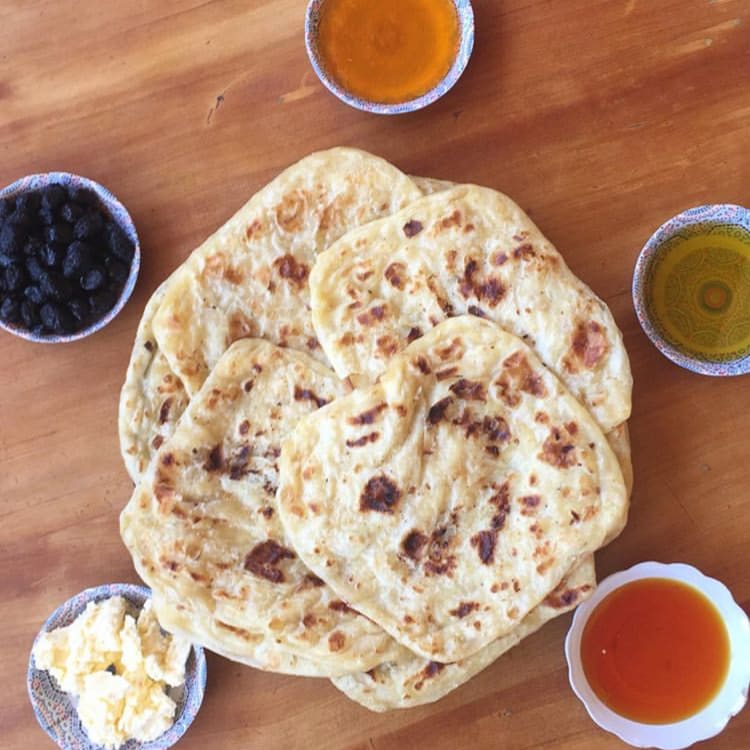
A traditional earthenware goat tagine cooked over charcoal.
Buy fresh rounds from rural women sitting along Rue Targui before 11:00.
Drink hot fava bean soup laced with garlic and local olive oil at small hole-in-the-wall spots near Bab el-Ain before 10:00.
Restaurants directly on charge up to 40% more than spots two alleys behind.
05
Founded in 1471 as a small fortress against Portuguese invasions, Chefchaouene grew rapidly when Sephardic Jews and Muslim Moors fled Spain after the Reconquista. The refugees rebuilt the city in the architectural image of Andalusian villages. For centuries, the mountain settlement remained closed to foreigners under religious protection decrees. Spanish troops occupied the city in 1920, breaking its historical isolation.
Fortress founded
Moulay Ali ibn Rashid establishes a stronghold to attack Portuguese garrisons on the northern coast.
Andalusian exile
Exiled Spanish Jews and Muslims settle in the town, establishing the whitewashed Andalusian quarter.
Spanish occupation
Spanish forces capture the city, integrating it into the Spanish Protectorate of northern Morocco.
Moroccan independence
Chefchaouene rejoins the sovereign Kingdom of Morocco as Spanish troops withdraw.
06
Choose your hotel location by your luggage weight and mobility limits. Properties in the upper medina require walking up hundreds of stone steps with your bags. Stays near Bab el-Ain or Place Mohammed V offer flat road access and taxi drop-offs.
Highly rated hotels in Chefchaouene.
See more Chefchaouene hotels07
No motor vehicles operate inside the medina walls. You walk everywhere on cobblestone steps, making sturdy shoes mandatory. Blue petit taxis navigate the asphalt roads outside the historical walls for fixed local fares.
From TNG (Tangier Ibn Battouta Airport)
Grand taxi private charter directly from Tangier Airport terminal to Bab el-Ain.
Pre-booked door-to-door driver waiting at arrival hall.
Men with blue handcarts wait at Bab el-Ain. Pay 20–30 MAD to haul heavy luggage up the medina stairs.
Blue taxis connect the lower CTM bus station to Bab el-Ain for a flat 15 MAD inside city limits.
Buy your CTM return bus ticket to Tangier or Fes 24 hours in advance; afternoon departures sell out.
Grand taxi drivers and bus station luggage handlers accept cash in Moroccan Dirhams only.
08
Chefchaouene costs noticeably less than Marrakech or Tangier. Credit cards work at higher-end riads, but street food, market stalls, and local transport operate entirely on cash in Moroccan Dirham (MAD).
Served hot with olive oil and cumin at small medina stalls.
Standard price in mid-range medina sit-down places.
Sold by rural vendors on street steps every morning.
Flat rate between lower bus station and medina gates.
09
MAR – MAY
Daytime temperatures stay around 20°C. Wildflowers cover the surrounding Rif mountains.
JUN – AUG
Temperatures top 35°C in afternoon heat. Heavy day-tripper crowds fill narrow alleys.
SEP – NOV
Warm clear days with evening mountain chills. Ideal conditions for hiking to Akchour.
DEC – FEB
Cold wet weather drops night temperatures near freezing. Unheated riads require warm layers.
10
Always ask permission before photographing residents sitting at their doorways.
Decline unwanted walking guide offers firmly with a polite 'Lla, Shukran'.
Withdraw cash at ATMs near Place Mohammed V before entering the deep medina.
Smooth painted stone steps become extremely slippery after rain. Wear grippy shoes.
Shops and cafes shut down for Friday afternoon prayers between 12:00 and 15:00.
Contents
Your trip
Going to Chefchaouene?
Tell Parley when you’re going and what you enjoy, and it plans the days around this guide.
Plan with Parley


