
landmark
Salzwelten Hallstatt
The oldest salt mine in the world. Ride the Salzbergbahn funicular up and slide down wooden miners' slides inside the mountain.
Austria
A high-alpine lake shaped by 7,000 years of salt mining.
Hallstatter See sits wedged between steep limestone cliffs and the Dachstein Alps. You move across the water by electric boat or wooden ferry, as no continuous shore road exists around the lake. The village of Hallstatt fills a narrow spit on the western bank, where space is so limited that houses cling directly to the rockface.
Steeg / Bad Goisern — Rural river valley town at the northern tip of the lake.
01
landmark
The oldest salt mine in the world. Ride the Salzbergbahn funicular up and slide down wooden miners' slides inside the mountain.
landmark
A 12th-century chapel holding over 600 hand-painted human skulls. Space in the small graveyard was recycled every fifteen years.
landmark
Massive underground ice domes reached via cable car from Obertraun. Heavy jackets are necessary inside even in mid-August.
landmark
Five metal platforms jutting over a 400-meter drop on Mount Krippenstein. One platform features a glass floor for direct vertical lines.
02
03
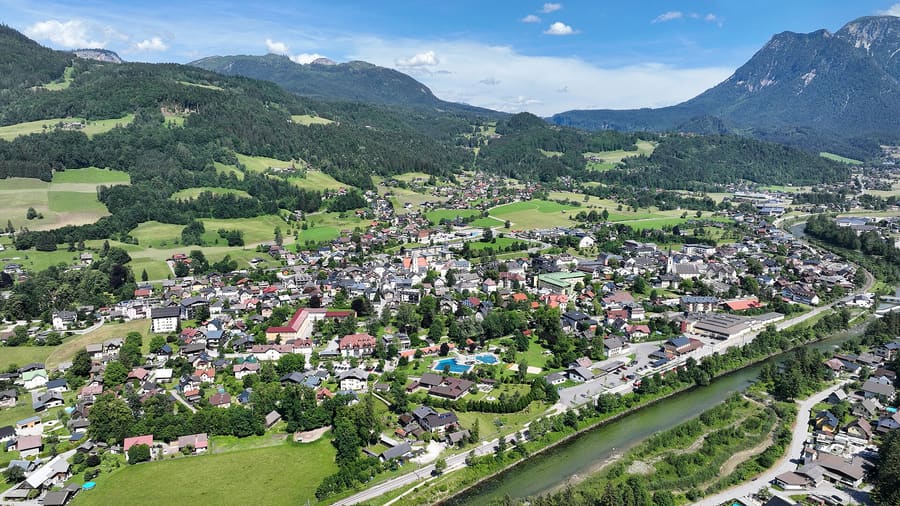
Sprawling lakefront village across the bay.
NearbyKrippenstein Cable Car, Obertraun Station
Ask ParleyRural river valley town at the northern tip of the lake.
NearbySteeg-Gosau Station, Traun River
Ask Parley04
Dining around Hallstatter See focuses entirely on lake catches. Reinanke and Saibling come directly from the cold, deep waters of the lake. Restaurants along Seestraße prepare these whitefish pan-fried in butter or grilled whole with boiled potatoes.
Local Arctic char served whole. Ask for fish caught in the lake rather than farmed variants imported from larger commercial hatcheries.
Village kitchens close early. Most lakefront places take final food orders by 20:00.
05
Salt extraction began here during the Bronze Age, making Hallstatt one of the oldest industrial sites on earth. The area gave its name to the early Iron Age Hallstatt Culture. Wealth built from rock salt created global trading connections that predated the Roman Empire.
First salt harvesting
Neolithic inhabitants collect natural brine from mountain springs above the lake.
Hallstatt Era
Underground mining expands rapidly, giving the town's name to the European early Iron Age.
Brine pipeline built
Engineers build a 40-kilometer wooden pipeline to transport brine to Ebensee saltworks.
First road connection
Workers blast a road into the cliff face, ending centuries of sole boat access.
06
Choose your base by your transit plans and tolerance for day-trip crowds. Hallstatt Markt offers atmospheric stays in historic houses once the day-trippers depart. Obertraun provides open space, shore access, and direct cable car routes to the ice caves.
07
The public transit network revolves around the ÖBB train line on the east bank and ferry connections across the lake. Hallstatt village center bans non-resident motor vehicles.
From Salzburg Airport (SZG)
Bus 150 to Bad Ischl, train to Hallstatt stop, then Stefanie ferry across the lake to Markt.
Drops at Hallstatt Lahn; cars are banned in the historic village center.
Drops at Lahn parking barrier outside the pedestrianized core.
Park at P1 or P2 in Lahn south of the tunnel. Walk into center.
Runs year-round between Hallstatt Bahnhaltestelle (train stop) and Hallstatt Markt dock, timed precisely to train arrivals.
Connects Hallstatt Lahn with the Dachstein cable car base station in Obertraun and Gosausee.
Located south of the tunnel in Lahn. Automatic barriers block cars from entering the pedestrian core.
Small electric motorboats are available for private rental on the waterfront during summer months.
08
High tourism volume keeps prices inside Hallstatt village above regional Austrian averages. Space constraints limit supermarket availability and cheap dining choices.
Standard price point for fresh lake fish in sit-down waterfront taverns.
Small entry fee goes directly to maintaining Saint Michael Chapel.
09
DEC – FEB
Crisp mountain snow and dark lake reflections. Funicular and salt mine close briefly for annual maintenance.
MAR – MAY
Spring thaws clear mountain trails. Ferry schedules increase as day-trip numbers rise steadily.
JUN – AUG
Peak tourist season with heavy day-tripper volume. Book accommodations four months in advance.
SEP – NOV
Morning mist sits over the lake water. Autumn foliage peaks across the surrounding limestone slopes in October.
10
Drone operation is strictly illegal across the entire municipal boundary of Hallstatt without a specific civil aviation permit.
Paid turnstile restrooms operate at the Lahn bus terminal and near the central boat landing. Carry €1 coins.
Smaller souvenir shops and food kiosks inside Hallstatt do not take payment cards under €10.
Residential houses line the narrow paths. Do not step onto private balconies or garden steps for photos.
Cobblestones and hillside staircases are slick during rain and winter frost. Wear shoes with deep tread.
Contents
Your trip
Going to Hallstatter See?
Tell Parley when you’re going and what you enjoy, and it plans the days around this guide.
Plan with Parley


