
landmark
Hahnenkammbahn & Streif
The world's most famous downhill race course. Walk the steep slope in summer or ski it in winter.
Austria
Tyrolean ski royalty driven by alpine sport and high prices.
Kitzbuhel is a medieval mining town turned global winter sports capital. The pedestrian core packs high-end boutiques and pastel gables, with its 13th- and 14th-century fortifications mostly integrated into buildings over time rather than remaining as intact walls. Efficient cable cars lift you directly from town to two distinct mountain flanks. Expect sharp prices, impeccable infrastructure, and crowds that peak during January race weekends.
01
landmark
The world's most famous downhill race course. Walk the steep slope in summer or ski it in winter.
landmark
Parallel pedestrian streets lined with 16th-century painted gables, boutiques, and cafes.
landmark
Moorland lake that warms up for summer swimming and freezes for winter ice skating.
landmark
Gothic church featuring baroque interiors and a cemetery filled with wrought-iron crosses.
02
03
Residential hillside offering sweeping views over the valley and town.
NearbyLebenberg Castle and hiking trails.
Ask ParleyPedestrian medieval lanes, high-end shopping, and classic Tyrolean taverns.
NearbyMuseum Kitzbuhel and Vorderstadt cafes.
Ask ParleyQuiet lakeside district surrounded by pine trees and wellness resorts.
NearbySchwarzsee moor lake and walking paths.
Ask ParleyTransit-focused hub built around ski lockers and cable car turnstiles.
NearbyHahnenkammbahn lift station and train stop.
Ask Parley04
Tyrolean cuisine relies on high-calorie mountain staples refined for international tastes. Regional cooking revolves around alpine butter, local beef, and dumpling preparations like Kaspressknödel. Mountain huts along the ski slopes operate as high-end restaurants during lunch service. Book table slots ahead if you plan to dine at mountain stations during peak winter months.
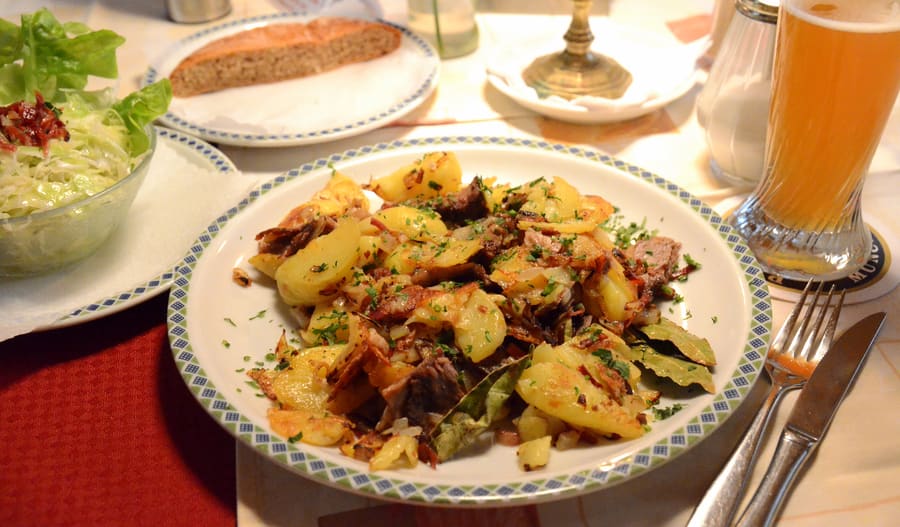
Tiroler Groestl served straight from the cast-iron skillet.
Order flat pan-fried cheese dumplings served in clear beef broth at Huberbräu Stüberl in the town center.
Reserve a terrace table at Sonnbühel on the Hahnenkamm slope for upscale seafood and Tyrolean wild game.
Kitchens in town close early. Most traditional Gasthäuser stop taking food orders by 21:00.
05
Kitzbuhel grew rich in the 16th century through copper and silver mining. When mining declined, the town pivoted early to winter sports, hosting Austria's first alpine ski races in the late 19th century.
Town charter granted
Duke Louis II of Bavaria grants Kitzbuhel town rights and defensive wall authorization.
Habsburg annexation
Emperor Maximilian I absorbs the silver-rich Kitzbuhel region into Habsburg Tyrol.
First ski descent
Franz Reisch skis down the Kitzbuheler Horn, starting the town's ski tourism industry.
First Hahnenkamm race
The initial international Hahnenkamm race takes place on the Streif slope.
06
Choose your stay by daily priority: fast cable car access or quiet historic atmosphere. Hotels in the Altstadt place you steps from restaurants, while properties near the Hahnenkammbahn save ski boot walking time.
07
The town core is completely pedestrianized and best covered on foot. Regional buses and local trains connect the town center to surrounding lift hubs and neighboring villages.
From Salzburg Airport (SZG)
Take Bus 2 to Salzburg Hbf, then ÖBB train to Kitzbühel.
Shared ski shuttle; must book in advance online.
Ranks outside terminal; extra charges may apply for oversized ski luggage.
You can walk across the main Altstadt pedestrian zone in under ten minutes.
Ski pass holders ride local post buses and ski buses for free between ski lifts.
The S-Bahn connects Kitzbuhel Hahnenkamm to Kirchberg and St. Johann in under ten minutes.
08
Kitzbuhel is one of Austria's most expensive resort towns. Expect high premium markups on mountain dining, luxury hotel stays, and peak-season ski passes.
Day rates vary depending on low or high winter season windows.
Standard price for traditional soup in town taverns and mountain huts.
Prices escalate quickly at high-end on-piste establishments like Sonnbühel.
Single ticket for non-skiers riding up the Hahnenkammbahn.
09
DEC – FEB
Peak ski season. High hotel prices, reliable snowpack, and crowded mountain slopes.
MAR – APR
Spring skiing on upper slopes. Sunnier days and declining accommodation rates.
MAY – JUN
Quiet shoulder season. Many cable cars shut down for routine maintenance.
JUL – SEP
Summer hiking season. Warm lake swimming at Schwarzsee and open alpine trails.
OCT – NOV
Low season transition. Cold rains common and major lifts remain closed.
10
Supermarkets and retail stores close completely on Sundays per Austrian federal law.
Credit cards are widely accepted, but small alpine huts occasionally require cash.
Main cable cars pause operations during May and November for maintenance breaks.
German is native, but service staff across hotels and restaurants speak fluent English.
Austrian red slopes are steeper than blue runs. Check slope maps before descending.
Contents
Your trip
Going to Kitzbuhel?
Tell Parley when you’re going and what you enjoy, and it plans the days around this guide.
Plan with Parley


