
landmark
Te Puia
Pōhutu Geyser erupts up to twice hourly. Tickets include access to the national Māori carving and weaving institutes.
New Zealand
Geothermal crust, Māori living culture, and world-class dirt.
Rotorua rests directly on a active volcanic caldera, where steam rises from roadside drains and sulfur scents the air. The city works as a dual hub for indigenous Māori culture and outdoor sports, sitting three hours south of Auckland. Moving between scattered thermal valleys requires private wheels or scheduled shuttles. Expect a functional regional hub wrapped around geothermal lakes, deep pine forests, and bubbling mud pools.
Lynmore — Residential enclave bordering redwoods, geared toward biking.
A traditional hāngī basket lifted from underground steaming pits.
01
landmark
Pōhutu Geyser erupts up to twice hourly. Tickets include access to the national Māori carving and weaving institutes.
landmark
Suspension bridges span giant California redwoods. Visit after dark to see ambient night-lantern light installations.
landmark
Tudor-style bathhouse grounds border Lake Rotorua. The central museum structure remains closed for seismic strengthening.
landmark
Acidic mineral pools soothe muscles on the lakefront. Book adult-only pools to avoid noise from family splash areas.
02
03
Dining precinct around Eat Streat and the lakefront boardwalk.
NearbyGovernment Gardens and Lake Rotorua lakefront.
Ask ParleyGeothermal suburb lined with thermal reserves and motels.
NearbyTe Puia and Whakarewarewa living village.
Ask ParleyResidential enclave bordering redwoods, geared toward biking.
NearbyWhakarewarewa Forest trailheads.
Ask Parley04
Hāngī relies on geothermal steam or heated underground stones to slow-cook pork, chicken, kūmara, and pumpkin over several hours. Traditional earth-oven meals are served during evening cultural performances across town. Lake Rotorua contains wild rainbow trout, but New Zealand law prohibits restaurants from buying wild game fish commercially. Diners must catch their own trout and bring it to a local restaurant kitchen to be prepared.
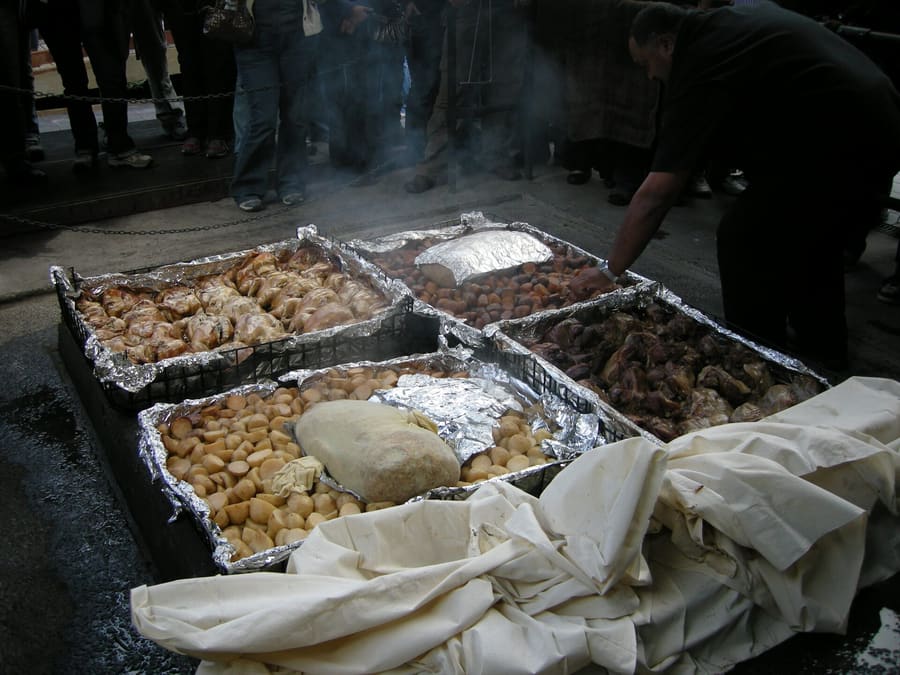
A traditional hāngī basket lifted from underground steaming pits.
Bring a legally caught rainbow trout to lakefront kitchens; chefs will fillet, smoke, or pan-fry it for a service fee.
Reserve evening Māori feast experiences 48 hours ahead during summer peak months.
Covered outdoor dining with thermally heated footpaths operates daily on Tutanekai Street.
05
Māori of the Te Arawa waka settled the Rotorua lakes district in the fourteenth century, utilizing hot springs for cooking and heating. European settlement accelerated in the 1880s as visitors sought the mineral waters of the Pink and White Terraces. The 1886 Mount Tarawera eruption destroyed those silica terraces, redirecting tourism focus to and Whakarewarewa.
Te Arawa Settlement
Māori navigators arrive at Lake Rotorua, establishing fortified villages beside geothermal steam fields.
Tarawera Eruption
Mount Tarawera erupts overnight, destroying Te Wairoa village and the Pink and White Terraces.
Bath House Opens
The government opens the Tudor-style Bath House to market Rotorua as a South Pacific balneology resort.
Arts Institute Founded
The New Zealand Māori Arts and Crafts Institute opens at Whakarewarewa to preserve traditional carving.
06
Choose your location based on your primary activity. Fenton Street suits travellers seeking budget motels with private geothermal plunge pools. Lynmore puts mountain bikers at the trailhead of Whakarewarewa Forest. Kawaha Point offers quiet water views away from city noise.
Highly rated hotels in Rotorua.
See more Rotorua hotels07
Rotorua is compact, but regional geothermal parks require road transport. Cityride local buses serve main residential suburbs and inner attractions, but services drop on weekends.
From Rotorua Airport (ROT)
Cityride Route 10 runs from terminal to i-SITE centre every 30 minutes on weekdays.
Available directly outside domestic arrivals terminal.
Uber pickup designated in main carpark.
Shared shuttle vans require advance booking or counter request.
Tag on and off with a Bee Card for lower bus fares than cash payments.
Local buses operate hourly on weekends; check timetables before heading out.
Picking up a rental car at ROT simplifies trips to Wai-O-Tapu and outer lakes.
Rideshare availability drops sharply after 10:00 PM on weeknights.
08
Rotorua prices reflect its status as an adventure and thermal destination. Activity admission costs form the largest part of a daily budget, while basic transit remains cheap.
Day pass covers geothermal valley, kiwi house, and carving institute.
Single adult fare paid via Bee Card across local zone routes.
Skyline gondola access plus three downhill luge runs.
09
DEC – FEB
Warmest weather (22–26°C) and peak visitor volume. Book forest tours and accommodation months ahead.
MAR – MAY
Crisp autumn air and stable temperatures (15–20°C). Ideal conditions for mountain biking and hot pools.
JUN – AUG
Cool winter days (10–14°C) maximize appeal of thermal soaking. High rainfall requires waterproof outer layers.
SEP – NOV
Spring weather shifts between rain and clear skies. Forest trails stay grippy and crowds remain light.
10
Hydrogen sulfide gas creates a distinct egg scent downtown; it is harmless and fades from notice quickly.
Purchase geothermal site tickets online to bypass morning ticket booth queues.
Shower thoroughly at station taps before entering shared mineral hot springs.
Whakarewarewa mountain bike tracks operate strict one-way directions; check trailhead signs.
Municipal tap water is safe, but never drink from unmonitored thermal springs or streams.
11
2025
Rotorua Museum RestorationThe iconic Bath House building in remains closed for major seismic strengthening, with re-opening works progressing into 2026.
Contents
Your trip
Going to Rotorua?
Tell Parley when you’re going and what you enjoy, and it plans the days around this guide.
Plan with Parley


